
Eyeglasses
Spectacle correction, updated as the refraction changes. Prescribed by optometrists and ophthalmologists; dispensed by opticians.
Surgical Co-Management · Refractive
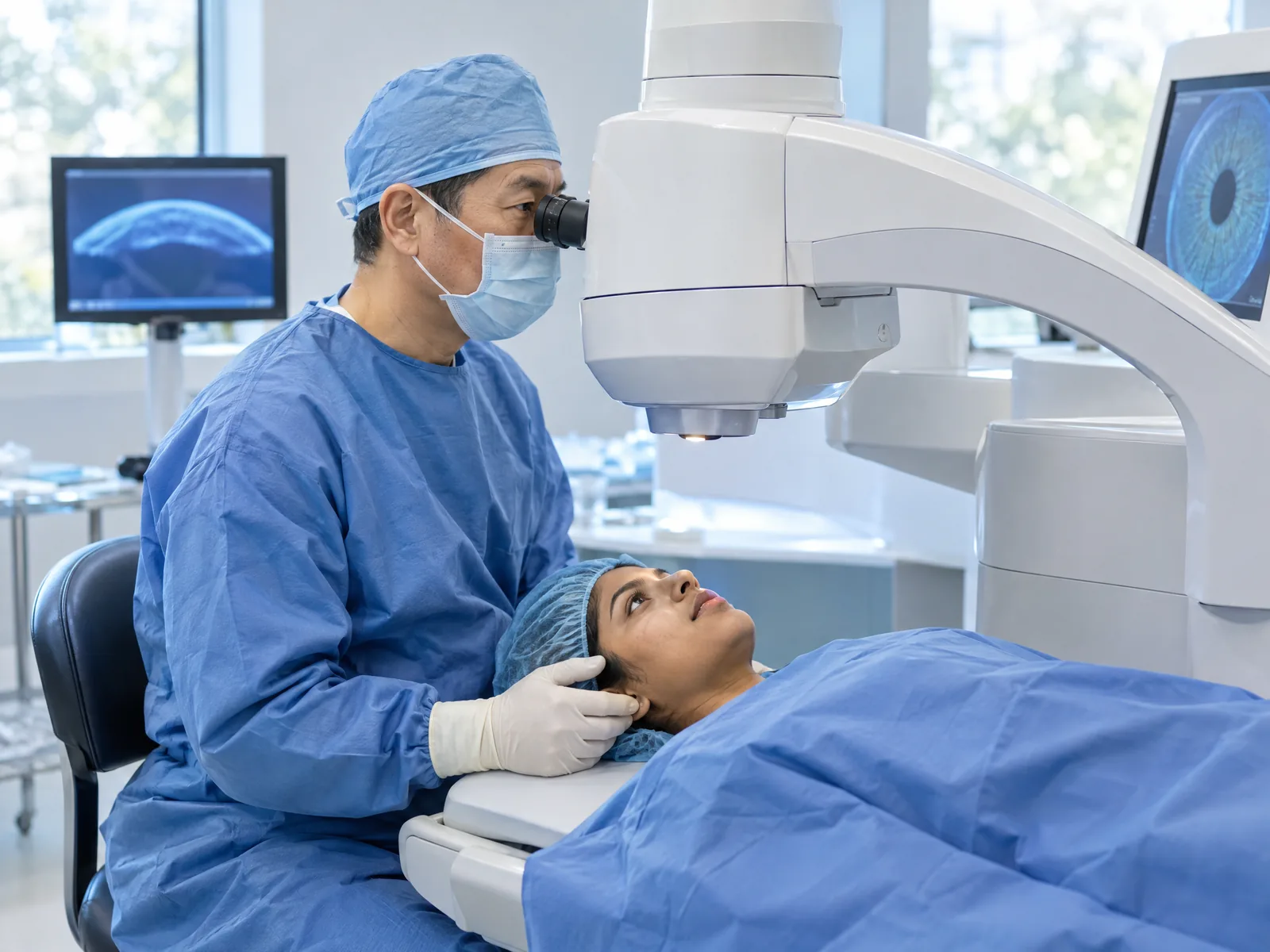
A femtosecond laser cuts a thin lenticule inside the cornea, removed through a small incision.
Quick answer
SMILE treats nearsightedness with or without astigmatism by removing tissue from inside the cornea. For surgeons and referring doctors, screening looks much like LASIK screening: stable refraction, healthy corneal shape and a treated ocular surface. Post-op care centers on the incision, the interface and dryness.
Treatment paths
NEI lists eyeglasses, contact lenses and surgery as the ways to correct refractive error. Vision Rescue does not rank these paths; the treating doctor and the patient choose based on the eye, the goals and the patient's circumstances.
Spectacle correction, updated as the refraction changes. Prescribed by optometrists and ophthalmologists; dispensed by opticians.
Soft or rigid lenses fitted to the eye. Fitted by optometrists and ophthalmologists.
LASIK, PRK or SMILE reshape the cornea. Refractive surgeons (ophthalmologists); pre- and post-op care by the surgeon or a co-managing OD or MD.
EVO ICL implanted in front of the natural lens. Ophthalmic surgeons, in an ASC or office surgical suite.
Natural lens replaced with an IOL. Cataract and refractive surgeons.
How it works
The sequence below summarizes how the procedure is described by its manufacturer.

The femtosecond laser outlines a lenticule within the stroma and a small access incision.
The surgeon separates the lenticule and removes it through the incision.
Removing the lenticule changes the corneal curvature and the refraction.
Surgeons and referring doctors who share how they weigh SMILE, LASIK and PRK give patients consistent counseling in both offices.
RescueLink
Laser vision correction can aggravate dry eye, and severe cases can persist. When the surgeon clears it, send patients an eligible over-the-counter list of preservative-free drops, lid care and night protection through RescueLink. Your practice earns a 15% participation credit on eligible OTC orders on VisionRescue.com.
Yes. ZEISS announced FDA approval of the VISUMAX 800 with SMILE pro software on January 11, 2024, for nearsightedness with or without astigmatism.
The 2024 U.S. approval covers myopia with or without astigmatism. Check current labeling for any other indications.
ZEISS reports lenticule creation in under 10 seconds with a 2 MHz pulse rate, based on data on file.
Both. It is meant for ophthalmic surgeons and ASCs as well as the optometrists and ophthalmologists who refer and co-manage, and it presents facts rather than recommending one approach.
Incision healing, interface clarity, inflammation and dry eye, plus refraction once stable.
Written for licensed eye care practices by the Vision Rescue team from manufacturer, FDA, CMS and peer-reviewed sources. Questions: providers@visionrescue.com or 1-855-692-8024.
Information only. Candidacy, technique and outcomes are decided by the operating surgeon. Refractive surgery fees and co-management arrangements must follow federal and state law. Vision Rescue is a licensed pharmaceutical wholesale distributor.
Patients ask about SMILE by name. An accurate answer, alongside glasses, contacts and the other procedures, serves them in any office.
Stay current: Latest eye care industry news
SMILE, VISUMAX and SMILE pro are trademarks of Carl Zeiss Meditec. Review the device labeling for indications, contraindications and risks.