
Eye Care Coding Reference
CPT 92133 OCT of the optic nerve.
What the code covers, how it is billed for both eyes, why it is not paired with 92134 or 92137, how it fits with visual fields and fundus photos, the Medicare contractor LCDs and how often glaucoma scans are expected. Last reviewed October 2026.
In one paragraph
The glaucoma OCT code.
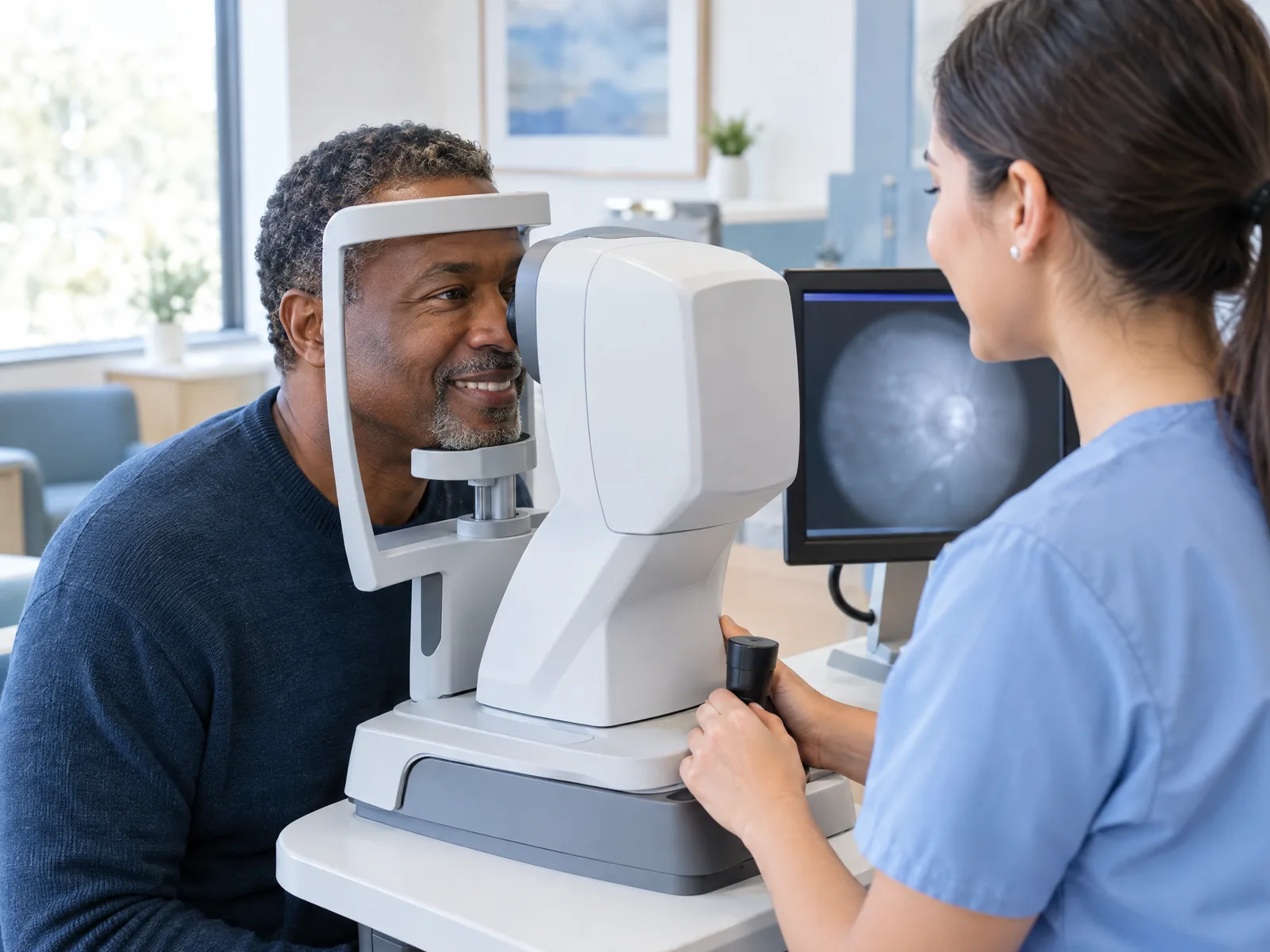
CPT 92133 covers computerized scanning imaging of the posterior segment focused on the optic nerve, most often OCT of the optic disc and retinal nerve fiber layer (RNFL), with the doctor's interpretation and report. It covers one or both eyes and is reported once per encounter. It is not reported with 92134 or 92137 at the same encounter, and Medicare treats it as generally mutually exclusive with fundus photography (92250). Medicare contractor LCDs typically expect one or two scans a year for glaucoma and glaucoma suspects. Descriptions on this page are Vision Rescue summaries, not the official CPT descriptor.
92133 at a glance
- Unilateral or bilateral: one unit per encounter
- Components: professional (26) and technical (TC)
- Not reported with 92134 or 92137 at the same encounter
- With 92250: generally mutually exclusive under NCCI
- Typical LCD frequency: up to 2 per year for glaucoma
- Common diagnoses: glaucoma and glaucoma suspect (H40)
What 92133 covers.
The code describes a quantitative scan of the optic nerve head and nerve fiber layer, read and reported by the doctor. The scan, the computer analysis and the written interpretation are one service.
Part of the service
- Acquiring the optic nerve scan, in one or both eyes
- Computer analysis, such as RNFL thickness and comparison to normative data
- Progression analysis against prior scans when available
- The doctor's interpretation and a signed written report
Professional and technical parts
| Modifier | Meaning |
|---|---|
| None (global) | The same practice performs the scan and interprets it |
| 26 | Professional component only: the interpretation and report |
| TC | Technical component only: the equipment, staff and scan |
Medicare contractor billing articles list the global and technical components as payable in the office and the professional component in hospital settings. The test is performed under general supervision.
One or both eyes, one unit.
The descriptor for 92133 includes both unilateral and bilateral testing. Medicare pays the same amount whether one or both eyes are scanned.
- 92133 is reported once per encounter, without modifier 50
- A scan of both eyes is still one unit of service
- Medicare contractor LCDs ask that the record show medical need for each eye when both are scanned
- Some payers have their own rules for a one-eye scan; check the payer
Same-day billing with other tests.
The most searched question is whether 92133 and 92134 can be billed together. They cannot. Here is how 92133 relates to the other tests a glaucoma or medical eye visit may include.
| Same encounter as 92133 | Rule | Source |
|---|---|---|
| 92134 retina OCT | Not reported together, even with a glaucoma and a retina diagnosis. The NCCI edit does not allow a bypass modifier. | CPT guidance; NCCI edit since 2011; AAO |
| 92137 retina OCT with angiography | Not reported together. | CPT guidance since January 2025 |
| 92250 fundus photography | Generally mutually exclusive. Both are paid only when each is medically necessary for the same eye, with modifier 59 or XU on 92250. | NCCI Policy Manual 2026, Chapter 11 |
| 92083 visual field | Separate tests. Some LCDs expect fields and OCT to alternate rather than be repeated on the same day in moderate glaucoma. | CGS LCD L34061 |
| 92020 gonioscopy | Separate test with its own medical necessity. | CPT |
| 92227 to 92229 remote retinal imaging | Paired with 92133 in NCCI edits. | NCCI edit tables |
AAO guidance is to choose the scan that gives the most information for that date when a patient needs both optic nerve and retina evaluation. Check the current NCCI tables for modifier indicators before relying on any pair.
OCT and visual fields in glaucoma.
Contractor policy treats structural and functional testing as complementary, with stage of disease guiding which test carries more weight.
| Stage | What one SCODI LCD expects |
|---|---|
| Glaucoma suspect or early glaucoma | Up to two optic nerve scans a year in most SCODI LCDs |
| Moderate damage | Alternating OCT and visual fields at sensible intervals; both on the same day or within about three months is the exception, with the reason documented |
| Advanced damage | OCT is not considered medically necessary; visual fields are the preferred test to follow change |
The moderate and advanced rows follow CGS LCD L34061. The CGS billing article A56692 adds that optic nerve scans would rarely be necessary or beneficial once optic nerve damage is advanced. Check your own contractor's LCD.
Medicare LCDs and covered diagnoses.
Several Medicare contractors publish a Scanning Computerized Ophthalmic Diagnostic Imaging (SCODI) LCD. The covered diagnosis lists sit in each LCD's billing and coding article, with a separate group for 92133 in some articles.
| Contractor | LCD | Billing article |
|---|---|---|
| First Coast Service Options (JN) | L33751 | Listed in the LCD |
| Novitas Solutions (JH, JL) | L35038 | A57600 |
| CGS Administrators (J15) | L34061 | A56692 |
| WPS (J5, J8) | L34760 | A56916 |
Kinds of diagnoses on the 92133 lists
- Glaucoma of all types and stages, and glaucoma suspect
- Optic neuritis and other optic neuropathies
- Papilledema and optic atrophy
- Optic disc drusen and pseudopapilledema
- Visual field defects
Not covered
- Screening a patient without signs or symptoms
- Testing that only confirms a diagnosis already established
- A diagnosis code on the list does not by itself prove medical necessity
The interpretation and report.
The interpretation is part of the code. A printout with no written reading is an incomplete service.
- A dated order with the clinical reason for the test
- Which eye or eyes were scanned and the signal quality or reliability
- Findings, such as RNFL thinning by sector or cup changes
- Comparison with prior scans and whether there is progression
- The diagnosis and how the result affects management
- The interpreting doctor's signature and date
The code itself did not change for 2026. Its wording was revised in 2025, when 92137 was added and CPT guidance began barring 92133, 92134 and 92137 at the same encounter. Payment for the posterior segment OCT codes was reduced in 2025. Medicare's 2026 fee schedule applied an efficiency adjustment to the work value of most non-time-based services, which may include diagnostic tests; check the 2026 fee schedule for your locality.
From Vision Rescue Pro
Supplies for glaucoma and medical eye practices.
Separate from the coding information above. Vision Rescue Pro is a licensed ophthalmic distributor serving imaging-heavy medical practices.
- In-office Rx at wholesale, including dilation and anesthetic drops
- Preservative-free products via RescueLink
- Price Match Guarantee
- Doctor Locator listing
Questions about CPT 92133
What is CPT code 92133?
It is the code for computerized scanning imaging of the optic nerve, usually OCT of the optic disc and nerve fiber layer, including the doctor's interpretation and report. It covers one or both eyes.
Can 92133 and 92134 be billed together?
No. CPT guidance and Medicare's NCCI edit do not allow both at the same encounter, even with a glaucoma diagnosis and a retina diagnosis. The edit does not accept a bypass modifier.
How often can you bill 92133?
Medicare contractor LCDs typically expect one or two optic nerve scans a year for glaucoma or glaucoma suspects. More frequent testing needs a documented reason. Check your contractor's LCD.
Is 92133 bilateral?
The code covers one or both eyes and is reported once per encounter, without modifier 50. Contractors expect the record to show the reason for testing each eye.
What diagnosis codes support 92133?
Contractor billing articles list glaucoma and glaucoma suspect codes, optic neuropathies, papilledema, optic atrophy, disc drusen and visual field defects, among others.
Can 92133 and a visual field be done on the same day?
They are separate tests, but some LCDs say that in moderate glaucoma doing both on the same day or within about three months should be the exception, with the reason in the record.
Sources
Medicare NCCI Policy Manual, Chapter 11, revised January 1, 2026; First Coast LCD L33751; Novitas LCD L35038 and article A57600; CGS LCD L34061 and article A56692; WPS LCD L34760 and article A56916; AAO coding guidance on billing 92133 and 92134 on the same day; ASRS retina coding update, 2025; Retina Today, OCT: What to Know for 2025; Review of Ophthalmology Coding and Reimbursement 2026 Update; CMS ICD-10-CM FY2026 code set.
Notes and disclosures
CPT is a registered trademark of the American Medical Association. Descriptions here are Vision Rescue summaries, not official CPT descriptors. This page is general information for eye care professionals and billing staff, not legal, billing or coding advice. Payer rules vary; verify codes, modifiers and coverage with the current official code sets, your Medicare contractor and the patient's plan. Questions: providers@visionrescue.com or 1-855-692-8024.
Measure the nerve, then manage the patient.
In-office Rx, preservative-free products and patient follow-through for glaucoma practices.