Flags inflammation
Picks up elevated MMP-9, an inflammatory marker frequently raised in the tears of dry eye patients.
In-office procedures · Diagnostic test
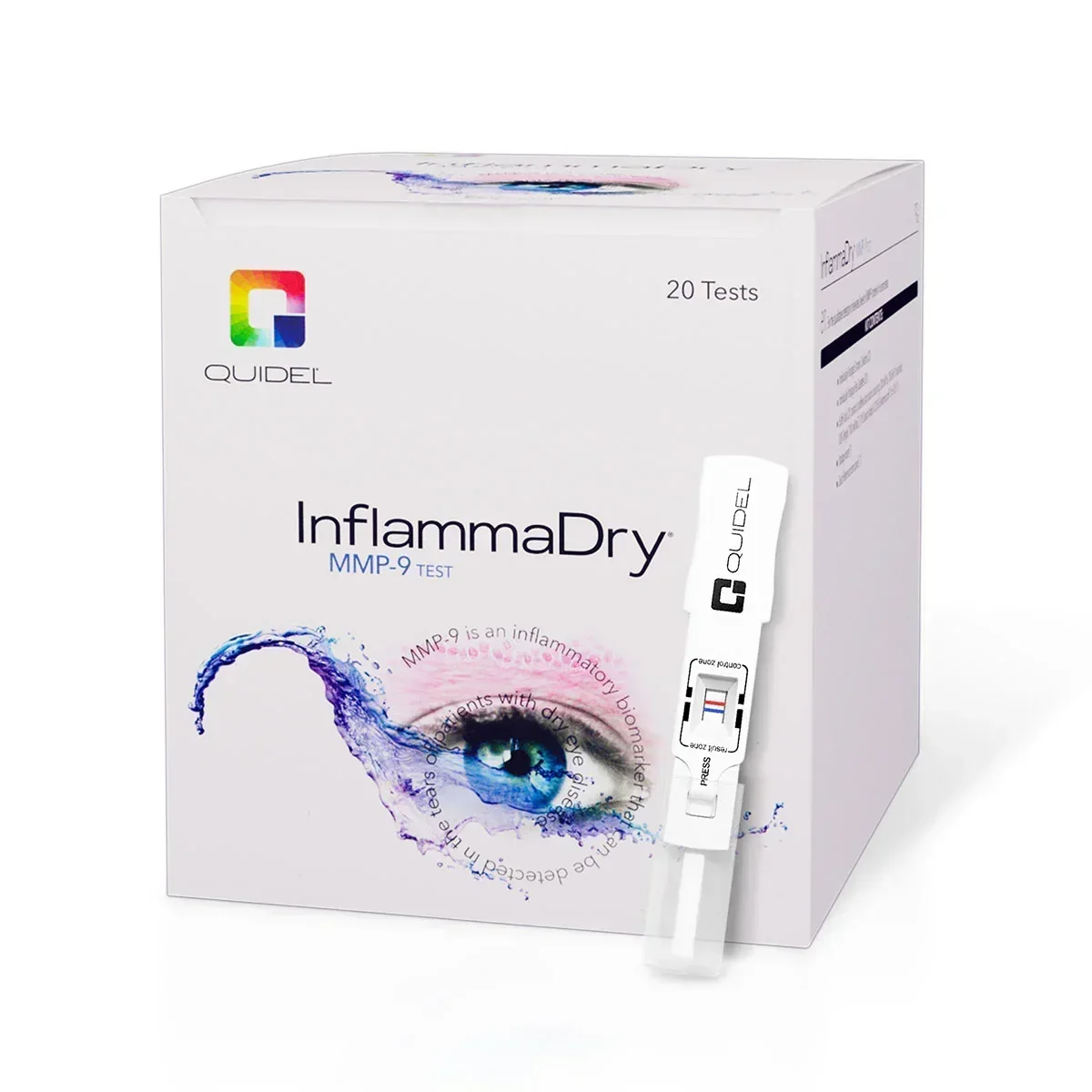
A CLIA-waived point-of-care test that flags elevated MMP-9 in tears, used by optometrists and ophthalmologists alike.
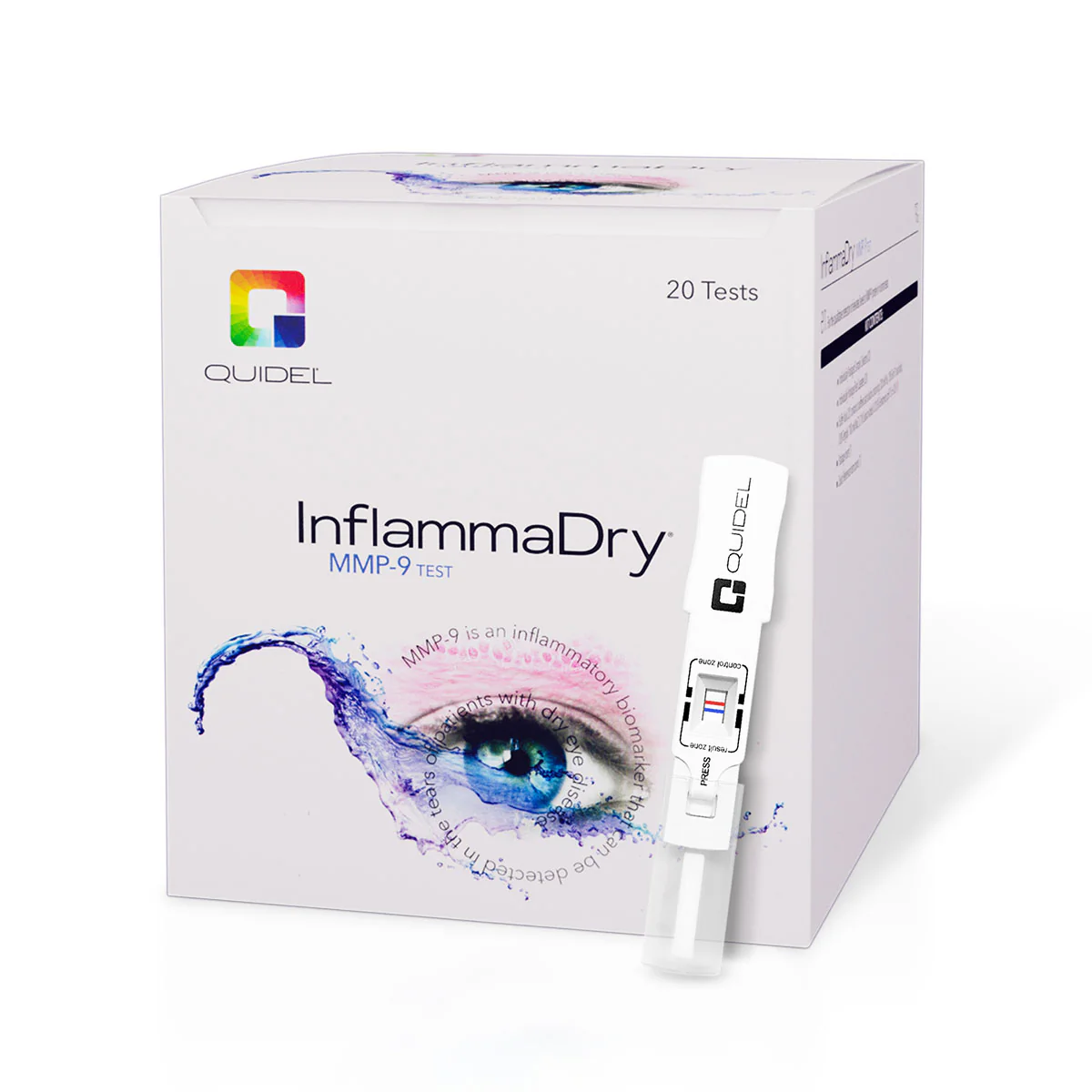
The sampling fleece picks up tears directly, and the sample runs on a lateral flow immunoassay that uses direct sampling microfiltration. Two antibodies capture MMP-9, and a two-color line readout shows whether it is elevated.
Picks up elevated MMP-9, an inflammatory marker frequently raised in the tears of dry eye patients.
Four simple steps produce a result within the same visit.
Built for point-of-care use in an eye care practice.
Ready out of the box, with no reader and no refrigeration needed.
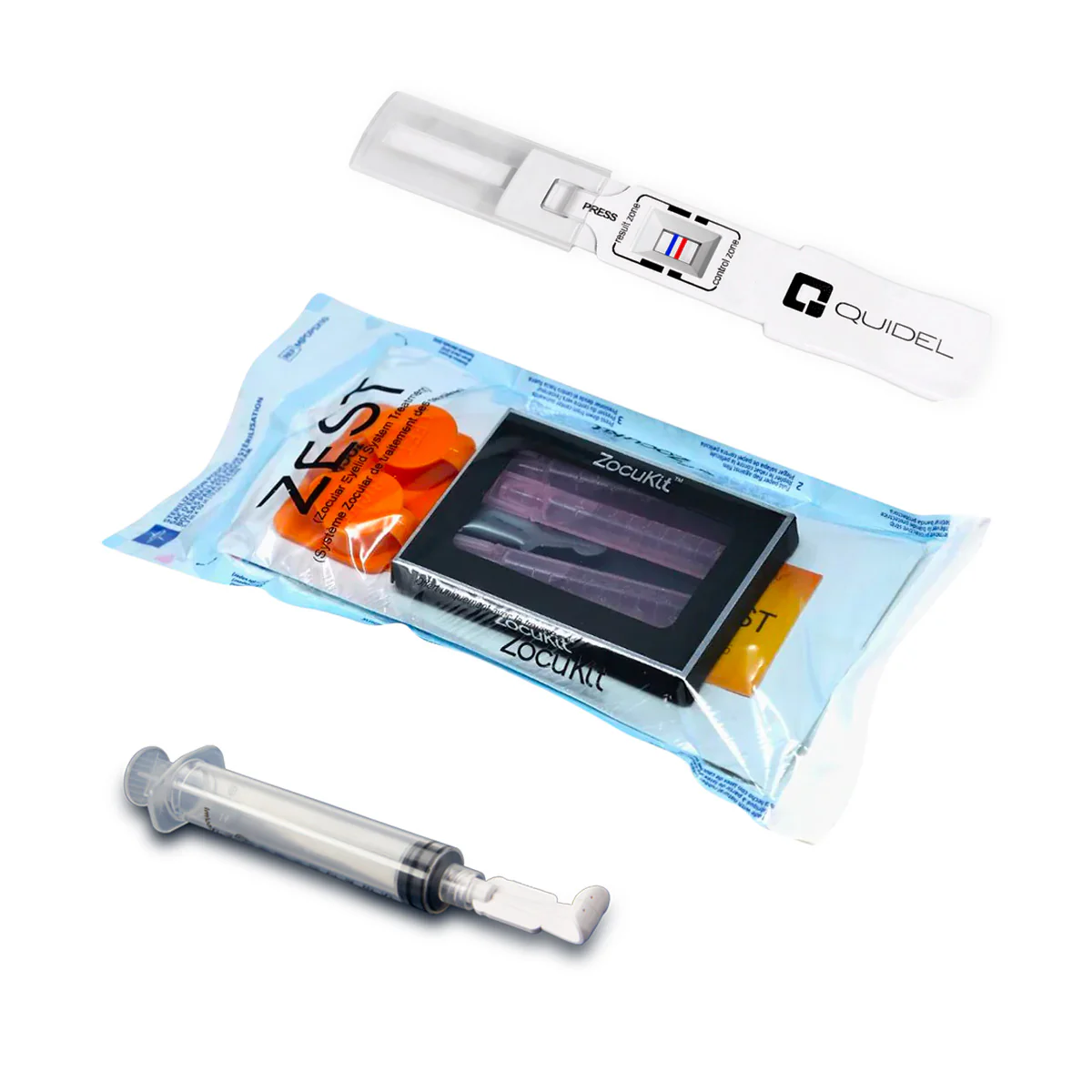
Every test includes a sterile sample collector, a buffer and a test cassette.
A sterile collector with a contoured tip and Dacron sampling fleece that collects tears directly.
A plastic cassette holding a lateral flow immunoassay strip built on direct sampling microfiltration.
A blue control line means the test is valid. Red and blue lines together read positive, and blue alone reads negative.
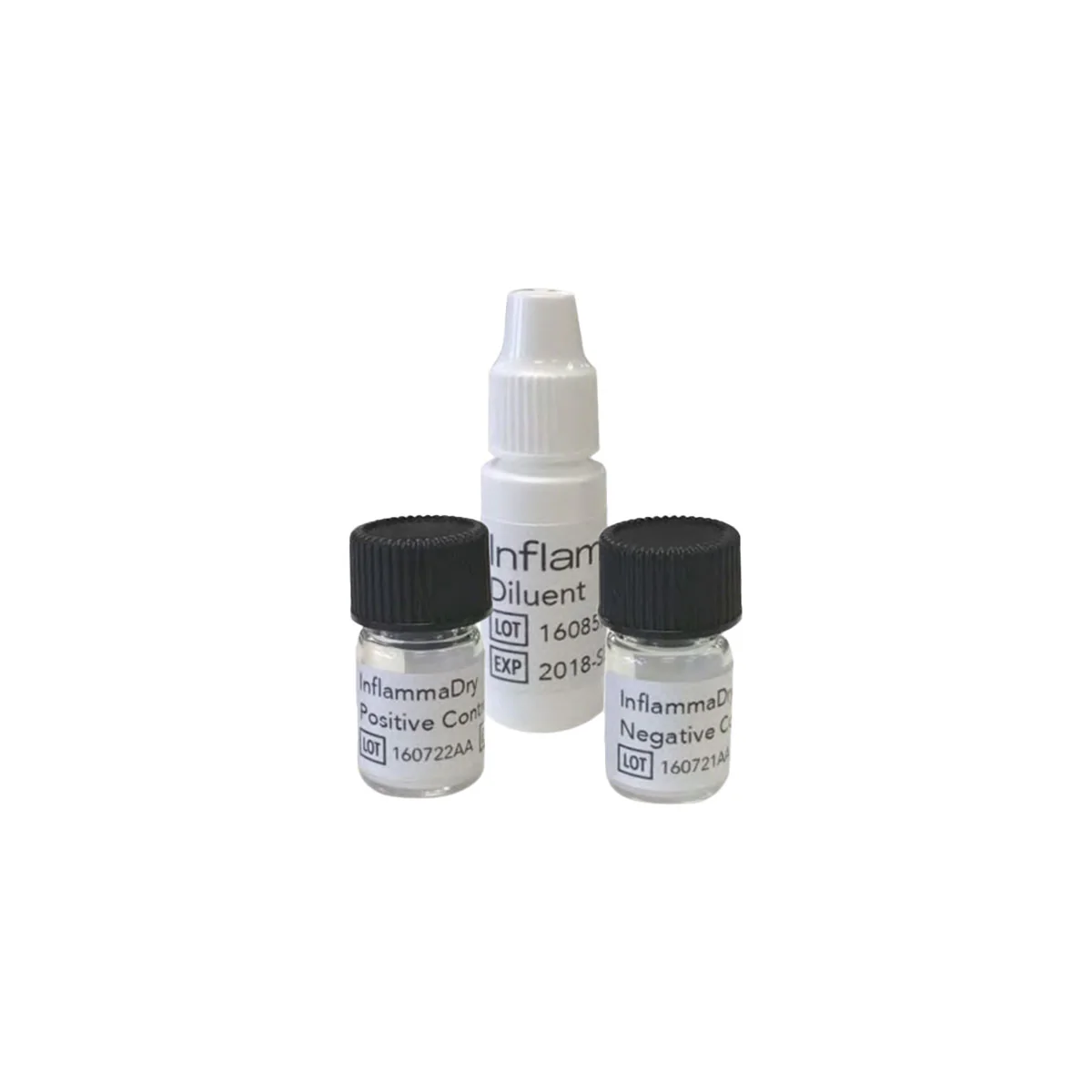
Positive and negative controls confirm the test is performing and help with staff training.
Run InflammaDry as part of the dry eye workup, before anesthetic, dyes or Schirmer testing.
Tears picked up directly from the eye by the sterile fleece. No pipettes and no extra equipment.
Four steps and a 10-minute wait for a visual result.
Prescription use only, at point-of-care sites. Controls go in with every new lot, every new shipment and every 30 days.
| Sample type | Human tears |
|---|---|
| Analyte | MMP-9 (matrix metalloproteinase-9) |
| Clinical cutoff | 40 ng/mL |
| Time to result | 10 minutes |
| Result format | Visual, qualitative, two-color lines |
| Positive agreement | 80.3% |
| Negative agreement | 98% |
| CLIA status | Waived |
| Storage | 4°C to 25°C (39°F to 77°F) |
| Test kit | RPS-ID-20-U, 20 tests |
| Control kit | RPS-DESTD, 1 positive and 1 negative control |
| External controls | Each new lot, each new shipment and every 30 days |
InflammaDry is a rapid, immunoassay test for the visual, qualitative in vitro detection of elevated levels of the MMP-9 protein in human tears from patients suspected of having dry eye to aid in the diagnosis of dry eye in conjunction with other methods of clinical evaluation. This test is intended for prescription use at point-of-care sites.
Treatment paths
Dry eye care runs from home care to surgery, and many patients use several paths at once. Vision Rescue does not rank these paths; the treating doctor and the patient choose based on severity, the main driver and the patient's circumstances.
Lubricant drops, gels and ointments, lid hygiene, warm compresses and nutrition. Usually the base layer at every severity.
Recommended by optometrists and ophthalmologists; done by the patient at home. Product guides ›
Anti-inflammatory and tear-film drugs such as cyclosporine, lifitegrast and perfluorohexyloctane, varenicline nasal spray, lotilaner for Demodex and short steroid courses.
Prescribed by ophthalmologists and optometrists within state scope. Prescription options ›
Gland expression, thermal pulsation and lid-heating devices, intense pulsed light, light therapy and lid-margin cleaning.
Offered in optometry and ophthalmology practices, often run by trained staff. In-office procedures ›
Temporary or long-lasting plugs that keep the patient's own tears on the eye, and permanent closure by thermal cautery when plugs are not enough.
Plugs placed by ODs and MDs where state scope allows; cautery closure is a surgical step, usually by an ophthalmologist. Punctal plugs ›
For severe disease: autologous serum drops, amniotic membrane, scleral lenses and eyelid surgery such as tarsorrhaphy.
Often cornea and oculoplastic specialists, with the co-managing OD or MD. Scleral lenses ›
Sources: TFOS DEWS III Management and Therapy (2025) · AAO Dry Eye Syndrome PPP (2023)
Manufacturers
Logos link to each company's website and appear in alphabetical order, at the same size, for identification only.

Elevated MMP-9, an inflammatory marker frequently raised in the tears of dry eye patients. The cutoff used clinically is 40 ng/mL.
The result is ready in 10 minutes.
Yes. It is CLIA-waived and meant for use by prescribers at point-of-care sites.
Store between 4°C and 25°C (39°F to 77°F). Refrigeration is not needed, and the test and buffer stay stable until the expiration date printed on the package.
With every new lot, every new shipment and every 30 days.
Before any ocular anesthetic, topical dye or Schirmer testing. If a topical medication has gone in the eye, allow at least 2 hours before taking the sample.
Yes. InflammaDry is used in optometry and ophthalmology practices, from primary eye care to cornea and surgical practices that check the ocular surface before surgery. Who may run and bill the test follows state scope of practice and the manufacturer's instructions.
A 10-minute, CLIA-waived test showing whether MMP-9 is elevated in a patient suspected of dry eye.
Stay current: Latest eye care industry news
InflammaDry is a trademark of QuidelOrtho. Read the complete manufacturer instructions for use, including every warning, precaution and contraindication, before use. Individual results vary.