









Insurance and Billing · Medical Insurance
Medicare and Medicare Advantage what Part B pays for in eye care.
Original Medicare leaves out routine vision care but covers a defined set of medical eye services. Knowing the line, and the codes CMS publishes for each covered service, keeps Medicare visits clean and patients informed before they owe.
Quick answer
Medical eye care yes, routine vision no.
Medicare does not cover routine eye exams or refractions for glasses and contacts. Part B does cover a yearly glaucoma screening for high-risk patients, a yearly diabetic eye exam, certain macular degeneration tests and treatments, cataract surgery with a conventional IOL, and one pair of standard glasses or one set of contacts after each cataract surgery with an IOL. After the Part B deductible, patients generally pay 20% of the Medicare-approved amount.
Key takeaways
- Routine exams and refractions for eyewear are not covered by Original Medicare.
- Glaucoma screening is covered once every 12 months for patients in defined high-risk groups.
- Bill glaucoma screening with G0117 or G0118 and diagnosis code Z13.5.
- Presbyopia- and astigmatism-correcting IOL functions are non-covered and reported with V2788 and V2787.
- Medicare Advantage plans may add routine exams and eyewear; follow each plan's rules.
What Part B covers in eye care.
From Medicare.gov and the CMS Medicare Vision Services booklet.
| Service | Coverage | Patient cost |
|---|---|---|
| Routine eye exam or refraction for eyewear | Not covered | Patient pays all costs |
| Glaucoma screening | Once every 12 months for high-risk patients | 20% after the Part B deductible, plus a copayment in a hospital outpatient setting |
| Diabetic eye exam | Once a year for patients with diabetes | 20% after the Part B deductible |
| Macular degeneration | Certain diagnostic tests and treatments, including some injectable drugs | 20% of the approved amount for drug and doctor services, after the deductible |
| Cataract surgery | Surgery with a conventional intraocular lens | 20% to the facility and the surgeon after the deductible |
| Glasses or contacts after cataract surgery | One pair of standard-frame glasses or one set of contacts after each surgery with an IOL | 20% after the deductible; patient pays for upgraded frames |
Eyewear after cataract surgery must come from a supplier enrolled in Medicare; DME suppliers bill their DME MAC.
Glaucoma screening, coded the CMS way.
A covered screening includes a dilated exam with intraocular pressure measurement and a direct ophthalmoscopy or slit-lamp exam.
| Item | CMS instruction |
|---|---|
| Who qualifies | Diabetes; family history of glaucoma; Black or African American and 50 or older; Hispanic or Latino and 65 or older |
| Who performs it | An optometrist or ophthalmologist legally authorized under state law, or staff under their direct supervision in their office |
| Documentation | The record must show the patient's high-risk group |
| Diagnosis code | Z13.5, encounter for screening for eye and ear disorders |
| HCPCS | G0117 by the optometrist or ophthalmologist; G0118 under their direct supervision |
| Cost sharing | Apply the patient's deductible and coinsurance |
Cataract and IOL codes CMS lists.
For practices that co-manage cataract patients, these are the codes the surgeon's office and facility report.
| Code | What it reports |
|---|---|
| 66984 | Extracapsular cataract removal with IOL insertion, one stage, without endoscopic cyclophotocoagulation |
| 66982 | Complex extracapsular cataract removal with IOL insertion, without endoscopic cyclophotocoagulation |
| V2632 | Posterior chamber intraocular lens, the most commonly reported conventional IOL code |
| V2787 | Astigmatism-correcting function of an IOL, a non-covered charge |
| V2788 | Presbyopia-correcting function of an IOL, a non-covered charge |
Tell the patient before surgery that Medicare does not pay for the presbyopia- or astigmatism-correcting portion of a premium IOL.
Use the Advance Beneficiary Notice as a conversation, not a form. CMS describes the ABN as a way to help patients decide on an item or service Medicare may not cover; for services Medicare never covers, a voluntary ABN does not change who is liable, but it does make the cost clear before the refraction.
RescueLink
Send the cash-pay products home with the patient.
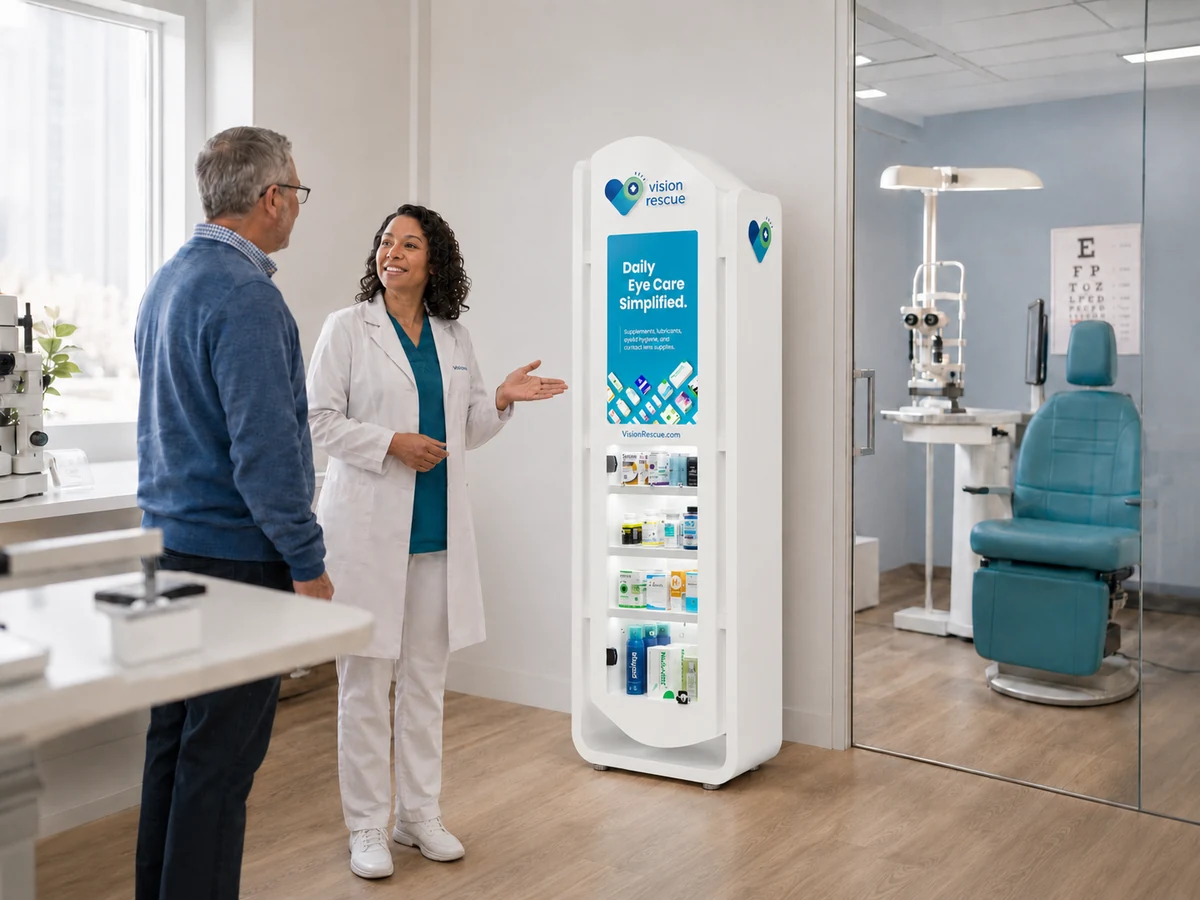
Vision and medical plans rarely pay for the drops, lid care and supplements a patient uses at home. Send the exact items by text or email; the patient orders in one tap, refills can run on auto-ship, and your practice earns a 15% participation credit on eligible OTC orders on VisionRescue.com. Contact lenses and Rx products are excluded.
- No setup fee, subscription or minimum
- One-tap ordering for the patient
- Optional auto-ship on refills
- Your recommendation stays with your practice
Questions practices ask
Does Medicare pay for a refraction?
No. Medicare does not cover routine eye exams, sometimes called eye refractions, for glasses or contact lenses.
How often is glaucoma screening covered?
Once every 12 months for patients in a high-risk group, performed or supervised by an eye doctor authorized under state law.
Is the diabetic eye exam covered?
Yes, once a year for patients with diabetes, with 20% coinsurance after the Part B deductible.
What eyewear does Medicare cover?
One pair of standard-frame glasses or one set of contact lenses after each cataract surgery that implants an IOL, from a Medicare-enrolled supplier.
Is a toric or multifocal IOL covered?
Medicare covers the conventional IOL. The astigmatism- or presbyopia-correcting function is non-covered and reported with V2787 or V2788.
What about Medicare Advantage?
An MA plan may add routine exams, frames every 24 months and lenses or contacts every 24 months. Check eligibility and billing rules with each plan.
References
- CMS Medicare Learning Network. Medicare Vision Services, MLN907165, June 2026. CMS (PDF)
- Medicare.gov. Eye exams (routine). Medicare.gov
- Medicare.gov. Glaucoma screenings. Medicare.gov
- Medicare.gov. Eye exams (for diabetes). Medicare.gov
- Medicare.gov. Macular degeneration tests and treatment. Medicare.gov
- Medicare.gov. Cataract surgery. Medicare.gov
- Medicare.gov. Eyeglasses and contact lenses. Medicare.gov
About this guide
Written for licensed eye care practices by the Vision Rescue team from plan, CMS and payer sources listed above. Questions: providers@visionrescue.com or 1-855-692-8024.
Important notes and disclosures
General business information only, not legal, billing or coding advice. Plan names, programs, policies and codes change; confirm details in each plan’s current provider manual and the member’s benefits before you bill. Vision Rescue is not affiliated with or endorsed by any plan named here. CPT is a registered trademark of the American Medical Association. Vision Rescue is a distributor of medical supplies and over-the-counter products.
Serve Medicare patients with fewer surprises.
Stock the essentials at wholesale and route take-home care through RescueLink.