
Why it matters
Dompé notes untreated NK may progress to a corneal ulcer, an open sore in the cornea.
OXERVATEBlack Friday: 15% off at 50 units · 20% off at 100 · 25% off at 200
Medical Eye Care · Prescription
OXERVATE (cenegermin-bkbj) ophthalmic solution 0.002% is a recombinant human nerve growth factor indicated for the treatment of neurotrophic keratitis.

The disease and the drug
Neurotrophic keratitis follows damage to corneal nerves, which impairs healing and can lead to persistent epithelial defects and ulcers. Cenegermin is a recombinant form of nerve growth factor. Identifying the disease early, and knowing how the eight-week course works, lets cornea specialists, comprehensive ophthalmologists and optometrists treat, refer or co-manage with confidence.
Dompé notes untreated NK may progress to a corneal ulcer, an open sore in the cornea.
OXERVATEReduced sensation is the core finding; an esthesiometer documents it objectively.
EsthesiometryComplete healing at week 8 was 72% versus 33.3% on vehicle in NGF0212, and 65.2% versus 16.7% in NGF0214.
LabelAmong healed patients, recurrence was about 20% in NGF0212 and 14% in NGF0214.
LabelThe regimen is demanding, so set expectations at the first visit.
One drop in the affected eye or eyes six times a day at two-hour intervals for eight weeks.
Weekly cartons of seven multiple-dose vials ship in an insulated pack with a delivery system kit of adapters, pipettes and wipes.
Pharmacies keep it frozen. After dispensing it is refrigerated for up to 14 days; an opened vial is discarded after 12 hours.
Remove lenses before dosing and wait 15 minutes before reinserting.
Treatment paths
Management follows stage and response. Vision Rescue does not rank these paths; the treating doctor and the patient choose.
Preservative-free tears and ointments, and stopping toxic or preserved drops.
Any treating OD or MDPunctal occlusion, a therapeutic soft contact lens or autologous serum tears.
Optometrists and ophthalmologists, within state scopeCenegermin drops six times a day for eight weeks.
Prescribed by ophthalmologists and optometristsA self-retaining membrane in the office, or a graft in the operating room.
Optometrists and ophthalmologists in office; surgeons in the ORTarsorrhaphy, corneal neurotization or keratoplasty for advanced disease.
Cornea and oculoplastic surgeons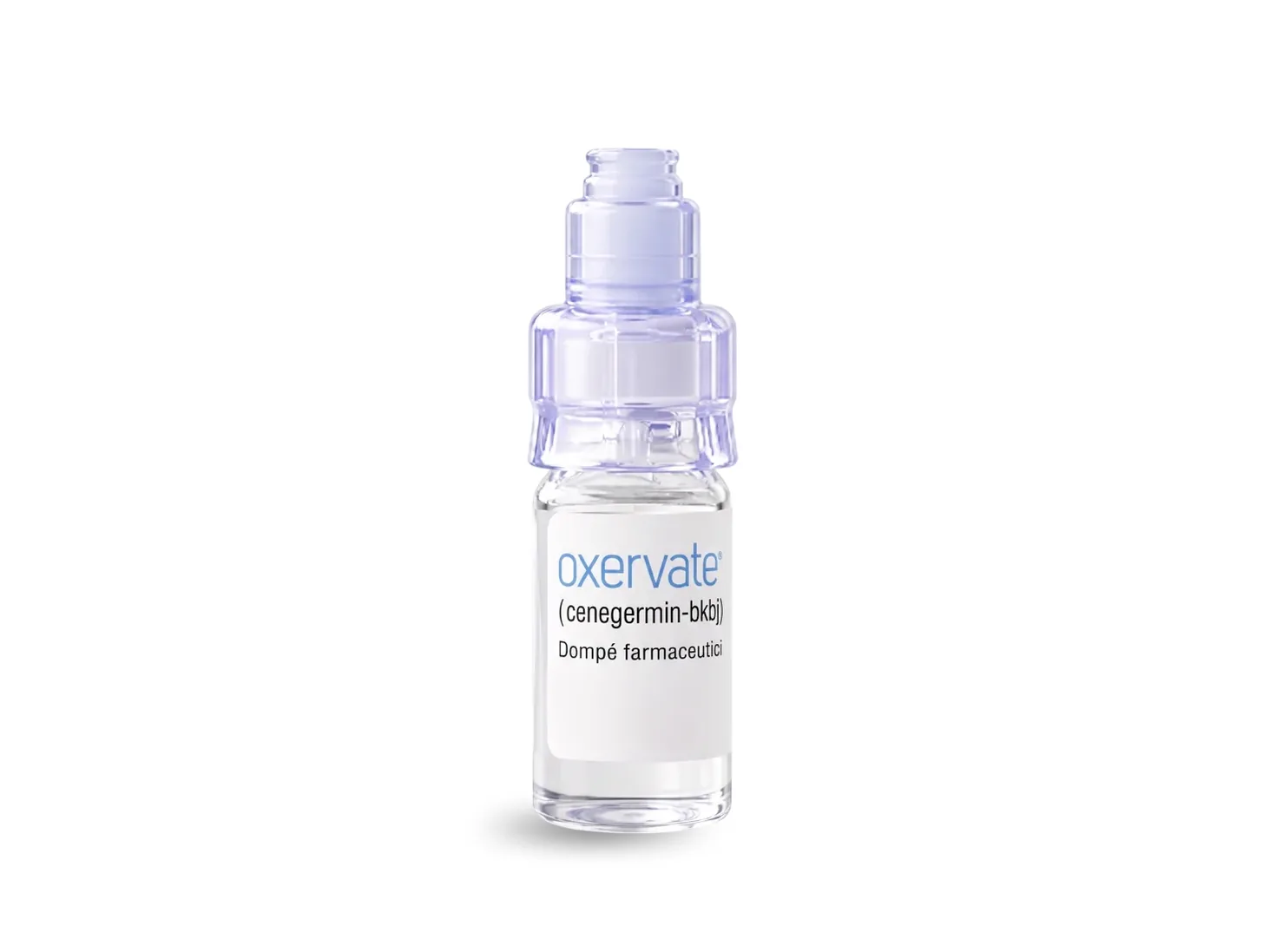
One multiple-dose vial is used per day and discarded after 12 hours.
Product photos
Each weekly carton holds seven vials and ships with a delivery system kit of adapters, pipettes and wipes.

In the clinic
Patients often have fewer symptoms than their staining suggests, because sensation is reduced.
Think of NK with persistent epithelial defects, a history of herpes, diabetes, corneal surgery or trigeminal injury, and reduced corneal sensation.
Document staining and test corneal sensation. Stop toxic or preserved drops where you can.
Prescribe the eight-week course through the specialty pharmacy or refer to a cornea specialist, train the patient on the kit, and follow healing closely.
OXERVATE (cenegermin-bkbj) ophthalmic solution 0.002% is indicated for the treatment of neurotrophic keratitis.
| Strength | 0.002% (20 mcg/mL) |
|---|---|
| Dosage form | Multiple-dose vial, ophthalmic solution |
| Pack | Weekly carton of 7 vials with a delivery system kit |
| Manufacturer | Dompé U.S. Inc. |
| Initial US approval | 2018 |
Treatment of neurotrophic keratitis.
One drop in the affected eye or eyes six times daily at two-hour intervals for eight weeks.
Complete corneal healing at week 8 was 72% versus 33.3% on vehicle in NGF0212, and 65.2% versus 16.7% in NGF0214.
Eye pain, reported in about 16% of patients.
Frozen at the pharmacy, then refrigerated after dispensing for up to 14 days. An opened vial is used for one day and discarded after 12 hours.
Esthesiometry. See the corneal sensation testing page for a non-contact option.
Test corneal sensation in patients at risk, and know the treatment path before you need it, whether you treat, refer or co-manage.
Stay current: Latest eye care industry news
OXERVATE is a trademark of Dompé farmaceutici S.p.A. Written for licensed eye care professionals. Review the full Prescribing Information before prescribing. Individual results vary.