
Mite-selective action
The drug targets GABA-gated chloride channels in the mite, paralyzing and killing Demodex.
Prescription treatment · Demodex blepharitis
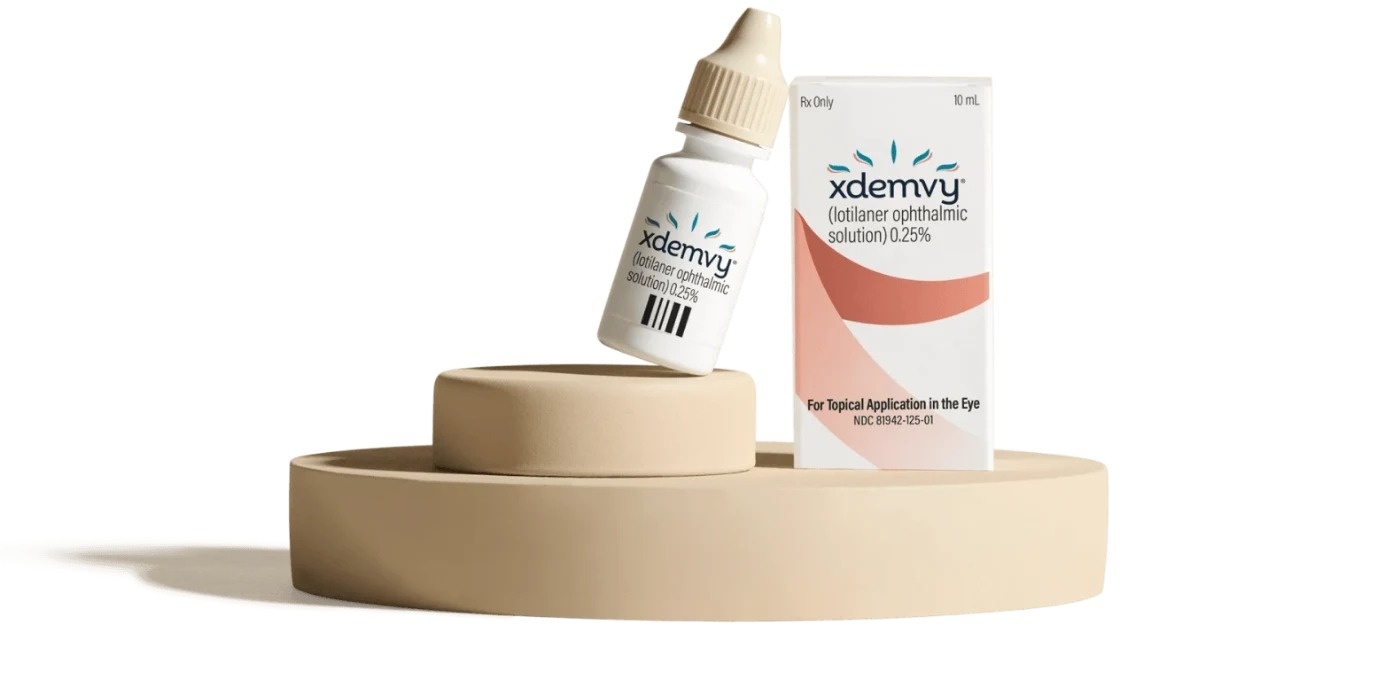
A prescription eye drop indicated for Demodex blepharitis, used at home and prescribed by ophthalmologists and optometrists within state prescribing rules.
Mechanism
Lotilaner inhibits gamma-aminobutyric acid (GABA)-gated chloride channels that are selective for mites. Blocking those channels paralyzes the mite and leads to its death. In vitro, lotilaner does not inhibit mammalian GABA-mediated chloride channels at concentrations up to 30 µM.
The drug targets GABA-gated chloride channels in the mite, paralyzing and killing Demodex.
At Day 43 in Saturn-1 and Saturn-2, 44% and 55% of patients on XDEMVY had 2 or fewer collarettes on the upper lid, compared with 7% and 12% on vehicle (p<0.01).
By Day 43, mite eradication reached 68% and 50% on XDEMVY, compared with 17% and 14% on vehicle (p<0.01).
Erythema cure at Day 43 was 19% and 30% on XDEMVY, compared with 7% and 9% on vehicle (p<0.01).
Across both studies, about 90% of patients on average rated the drop neutral to very comfortable.
A sterile aqueous eye drop in a multiple-dose bottle.
The active ingredient is lipophilic, dosed at 2.5 mg/mL, and selective for the GABA-gated chloride channels of mites.
Potassium sorbate is the preservative in this aqueous solution.
An opaque white LDPE bottle with an LDPE dropper tip and a tan HDPE cap, filled with 10 mL in an 11 mL container.
Prescribing
The eye care provider prescribes XDEMVY and the patient applies it at home.
One drop in each eye twice a day, roughly 12 hours apart, for 6 weeks. A missed dose is skipped and the patient resumes with the next scheduled dose.
Wait at least 5 minutes between XDEMVY and any other topical eye medicine. Contact lenses come out before the drop and can go back in 15 minutes later.
ePrescribe to an activated specialty pharmacy and list Demodex blepharitis with the matching ICD-10 code (B88.01 as of October 1, 2025).
XDEMVY is indicated for the treatment of Demodex blepharitis.
Contraindications: None
Risk of Contamination: Do not allow the tip of the dispensing container to contact the eye, surrounding structures, fingers, or any other surface in order to minimize contamination of the solution. Serious damage to the eye and subsequent loss of vision may result from using contaminated solutions.
Use with Contact Lenses: Contact lenses should be removed prior to instillation of XDEMVY and may be reinserted 15 minutes following its administration.
Adverse Reactions: The most common ocular adverse reaction observed in controlled clinical studies with XDEMVY was instillation site stinging and burning which was reported in 10% of patients. Other ocular adverse reactions reported in less than 2% of patients were chalazion/hordeolum and punctate keratitis.
| Dosage form | Sterile ophthalmic solution |
|---|---|
| Strength | Lotilaner 0.25% (2.5 mg/mL) |
| Dosing regimen | One drop per eye twice daily (about 12 hours apart) for 6 weeks |
| Package size | 10 mL fill in an 11 mL container |
| NDC | 81942-125-01 |
| Container | Opaque white LDPE multiple-dose bottle with LDPE dropper tip and tan HDPE cap |
| Storage | 15°C to 25°C (59°F to 77°F). Once opened, usable until the expiration date printed on the bottle. |
Treatment paths
Dry eye care runs from home care to surgery, and many patients use several paths at once. Vision Rescue does not rank these paths; the treating doctor and the patient choose based on severity, the main driver and the patient's circumstances.
Lubricant drops, gels and ointments, lid hygiene, warm compresses and nutrition. Usually the base layer at every severity.
Recommended by optometrists and ophthalmologists; done by the patient at home. Product guides ›
Anti-inflammatory and tear-film drugs such as cyclosporine, lifitegrast and perfluorohexyloctane, varenicline nasal spray, lotilaner for Demodex and short steroid courses.
Prescribed by ophthalmologists and optometrists within state scope. Prescription options ›
Gland expression, thermal pulsation and lid-heating devices, intense pulsed light, light therapy and lid-margin cleaning.
Offered in optometry and ophthalmology practices, often run by trained staff. In-office procedures ›
Temporary or long-lasting plugs that keep the patient's own tears on the eye, and permanent closure by thermal cautery when plugs are not enough.
Plugs placed by ODs and MDs where state scope allows; cautery closure is a surgical step, usually by an ophthalmologist. Punctal plugs ›
For severe disease: autologous serum drops, amniotic membrane, scleral lenses and eyelid surgery such as tarsorrhaphy.
Often cornea and oculoplastic specialists, with the co-managing OD or MD. Scleral lenses ›
Sources: TFOS DEWS III Management and Therapy (2025) · AAO Dry Eye Syndrome PPP (2023)
Manufacturers
Logos link to each company's website and appear in alphabetical order, at the same size, for identification only.

XDEMVY is indicated for the treatment of Demodex blepharitis.
One drop in each eye twice a day, about 12 hours apart, for 6 weeks.
The patient skips it and picks up with the next scheduled dose.
Yes, but lenses come out before each drop and can be put back in 15 minutes later.
At 15°C to 25°C (59°F to 77°F). An opened bottle is good until the expiration date printed on it.
Stinging and burning where the drop goes in, reported by 10% of patients in controlled clinical studies.
Ophthalmologists and optometrists both prescribe XDEMVY. Optometric prescribing authority is set state by state, so check your state's rules.
Read the complete Prescribing Information before you prescribe.
Stay current: Latest eye care industry news
XDEMVY is a trademark of Tarsus Pharmaceuticals, Inc. Read the complete Prescribing Information before prescribing. Individual results vary. Photo: Tarsus Pharmaceuticals.