









Practice Playbook
Growing a Dry Eye Center in Stages let each stage fund the next.
A dry eye center is built over time, not bought on day one. Add capability step by step, never ahead of patient volume, and let yes rates and repeat orders tell you when to move up.
In one paragraph
Three stages, unlocked by results.
Stage one is a screening habit, a small in-office assortment and RescueLink for everything else. Stage two brings point-of-care testing, a staff lead and more products on hand. Stage three adds procedures and, for busy offices, a product display. Advance only when the numbers support it.
Worth knowing
- Let each stage cover its own costs before you commit to the next one.
- Stage one needs almost no capital: a symptom question, a few products and RescueLink, which is free to activate.
- Testing and a dedicated owner make sense once screening volume is steady.
- Procedures and a display suit offices with enough patients to keep them busy.
- Many practices run a solid service at stage two and never need stage three.
The stages at a glance.
What each one adds, and the signal that you are ready for the next.
| Stage | Adds | Ready for the next when |
|---|---|---|
| One: screen and begin | A check-in symptom question, a small in-office assortment, RescueLink for the rest | Patients regularly accept plans and buy again |
| Two: confirm and assign | Point-of-care tests such as ScoutPro osmolarity and InflammaDry MMP-9, a staff lead, more products on hand | The routine runs without the doctor steering it and volume holds steady |
| Three: treat and expand | In-office procedures and their supplies, plus an optional product display | Confirmed patients are numerous enough to keep a procedure room and display busy |
Building blocks by stage.
Each card links to the guide for that piece.
Screening and a small assortment
A symptom question at intake plus four to six top sellers.
Point-of-care testing
Osmolarity and MMP-9 results give the patient an objective finding to look at.
A staff lead
A single owner for the routine, the stock and patient follow-up.
In-office procedures
Lid debridement, gland expression, thermal treatments and IPL.
Meibomian gland expression
Evaluate gland function, then express with the right technique and tools.
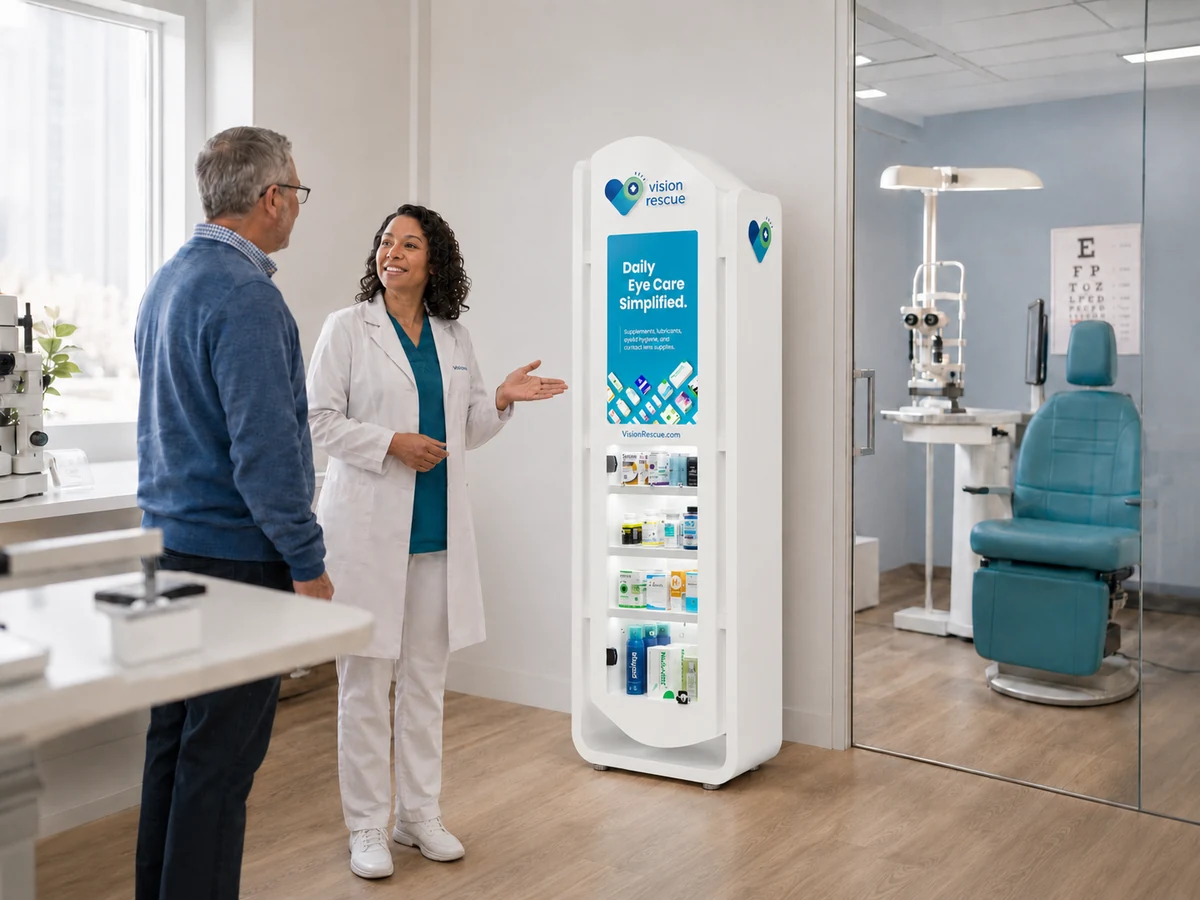
A product display
A self-serve unit for waiting rooms and optical areas with steady traffic.
Move up on data, not excitement. One strong month makes procedures tempting; wait until the repeat-order rate shows that demand holds before taking on procedure-level costs.
RescueLink
Send the rest home with the patient.
Text or email each patient the exact products you recommend. They check out in one tap on VisionRescue.com, refills can repeat automatically, and your practice receives a 15% participation credit on eligible OTC orders. Contact lenses and Rx products are excluded.
- Free to activate, no subscription
- Patients check out in one tap
- Automatic refills on daily items
- Your recommendation, your patient
Doctor questions about growing in stages
Why not build everything at once?
Costs arrive up front while patient volume builds slowly. Staging keeps spending in line with demand you have already seen.
What does stage one cost?
Very little: an intake question, a few starter products and RescueLink, which is free to activate with no subscription.
When should point-of-care testing start?
In stage two, once screening produces a steady stream of candidates.
When is a procedure room worth it?
When confirmed patients are numerous enough to keep the room and its supplies in regular use.
Must I reach stage three?
No. Plenty of practices run a strong service at stage two.
Can I scale back?
Yes. If demand softens, hold fewer products in the office, ship more through RescueLink, and expand again later.
About this guide
Prepared for licensed eye care practices by Vision Rescue. Reach the provider team at providers@visionrescue.com or 1-855-692-8024.
Notes and disclosures
General operating guidance, not clinical, legal, tax or billing advice. Outcomes vary with each practice's patients and execution, and treatment decisions belong to the examining doctor. Vision Rescue is a licensed pharmaceutical wholesale distributor of medical supplies and OTC eye care products.
Grow one stage at a time.
Order in-office products at wholesale, and use RescueLink for everything you are not ready to hold.